Why Cambodia Demands a Smart Connectivity Strategy
Cambodia is a country of incredible contrasts, from the sprawling, ancient stone corridors of Angkor Wat to the bustling, neon-lit streets of Phnom Penh. As a traveler, you will likely find yourself relying on your smartphone for everything from booking tuk-tuks via ride-sharing apps to translating Khmer phrases and finding the best hidden cafes. However, relying solely on your home carrier’s roaming plan can be a costly mistake that leaves you with limited data or throttled speeds.
For most modern travelers, the most efficient way to stay connected is by using dual SIM in Cambodia for data. This approach allows you to keep your primary phone number active for essential SMS messages or two-factor authentication codes while simultaneously running a local or travel-specific data plan. By separating your voice and data needs, you avoid the common pitfalls of international roaming, such as unexpected charges or the inability to access high-speed networks when you need them most.
Using a dual SIM setup is particularly advantageous in Cambodia because the local cellular infrastructure is generally reliable in urban centers but can be inconsistent in remote rural areas. By having a secondary data source ready to go, you ensure that you are never left without a map or a way to contact your accommodation. Whether you are using a physical SIM card slot or an eSIM, the ability to toggle between networks provides a level of security and convenience that single-SIM users often lack.
Setting Up Your Device for Dual SIM Functionality
Before you arrive in Cambodia, it is essential to verify that your smartphone is compatible with dual SIM technology. Most modern smartphones released in the last few years support either two physical SIM cards or one physical SIM and one eSIM. If you are using an iPhone or a modern Android device, you likely have the capability to handle two different service providers simultaneously.
To prepare your device, you should check your settings menu to ensure your phone is not carrier-locked. If your device is locked to a specific network provider in your home country, you will not be able to add a secondary plan, regardless of whether you are using a physical card or an eSIM. If your phone is unlocked, the process is straightforward. For those opting for an eSIM, which is the most convenient method for international travel, you simply need to scan a QR code or enter activation details provided by your service provider.
Once your secondary plan is active, you must configure your device to manage data usage correctly. Most operating systems allow you to assign specific roles to each SIM. You can designate your home SIM for voice calls and SMS, while selecting your travel eSIM as the primary source for cellular data. This configuration prevents your home carrier from triggering expensive roaming data charges while allowing you to receive important calls from home. OneTapSIM offers a seamless way to manage this transition, providing clear instructions on how to activate your travel data plan without interfering with your existing phone number settings.
The beauty of this setup is the flexibility it affords. You can switch your data source back to your home carrier with a single tap if you ever need to troubleshoot, but for the duration of your trip, your travel eSIM will act as the engine for all your digital needs. Remember to turn off "Data Roaming" for your primary SIM card in your phone’s cellular settings to be absolutely certain that your phone does not accidentally pull data from your home provider.
Maximizing Your Data Experience Across Cambodia
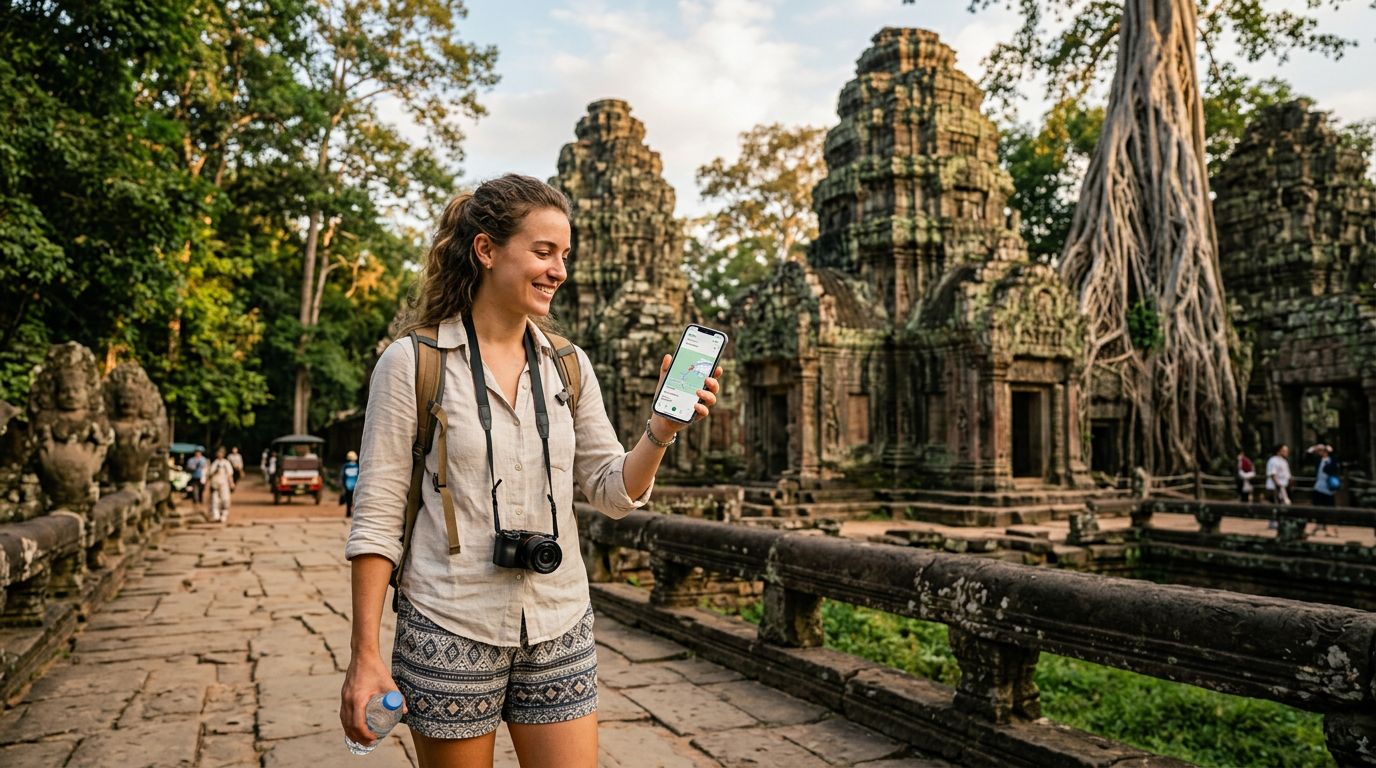
Once you have successfully mastered using dual SIM in Cambodia for data, the focus shifts to optimizing your usage. Cambodia’s digital landscape is growing rapidly, and having a reliable data connection allows you to participate in the local economy more effectively. From scanning QR codes for payments at street food stalls to navigating the complex layout of the Angkor Archaeological Park, a consistent data stream is your best travel companion.
When traveling between cities, such as moving from Siem Reap to the coastal regions or the capital, you may notice fluctuations in signal strength. While major providers cover the main highways, rural areas can be spotty. Because you are using a dual SIM setup, you have the advantage of being able to add a secondary travel eSIM if you find yourself in a region where your primary travel data provider has limited coverage. This redundancy is a hallmark of a seasoned traveler.
To keep your data usage efficient, consider downloading offline maps for the regions you plan to visit. While your eSIM will provide plenty of data for browsing and ride-sharing, downloading large files or streaming high-definition video while on the go can deplete your allowance quickly. If you are using a service like OneTapSIM, you can monitor your data consumption through your device’s built-in usage tracker, ensuring you stay within your limits throughout your entire journey.
Furthermore, remember to keep your software updated. Whether you are using an iOS or Android device, keeping your system software current helps ensure that your dual SIM management tools function smoothly. If you encounter any connectivity issues, a quick restart of your device or toggling "Airplane Mode" on and off is often enough to force the phone to re-establish a connection with the local towers.
By taking the time to set up your dual SIM configuration before you land at the airport, you eliminate the stress of searching for a kiosk or dealing with language barriers while trying to purchase a local physical SIM card. You arrive in Cambodia ready to explore, with your maps, translation apps, and communication tools fully functional from the moment you step off the plane. This proactive approach to connectivity ensures that your focus remains on the breathtaking temples, the vibrant culture, and the unforgettable experiences that Cambodia has to offer, rather than the logistics of staying online.
Get an eSIM for
Plans for the destinations covered in this guide, with instant QR delivery.