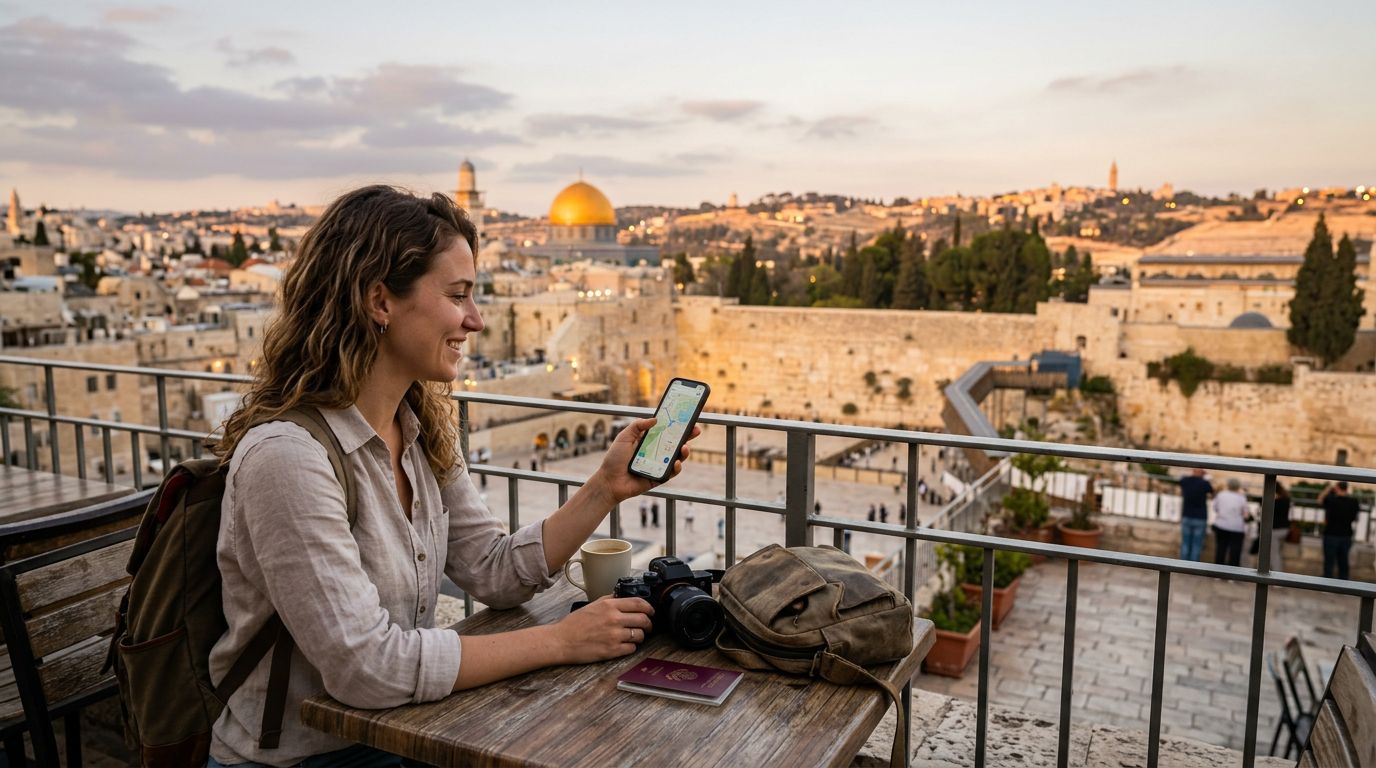
Why Reliable Connectivity Matters in Israel
Planning a trip to Israel involves balancing historical exploration with modern logistics. Whether you are wandering through the narrow, ancient alleys of the Old City of Jerusalem, relaxing on the beaches of Tel Aviv, or hiking in the Galilee, staying connected is essential. Having constant access to mobile data allows you to use navigation apps to find your way through complex street layouts, translate menus, access public transportation schedules, and share your experiences with friends and family in real time.
Many travelers arrive in Israel and immediately start searching for the best way to get data in Israel. Relying solely on public Wi-Fi is rarely a viable strategy. While major hotels and some cafes offer internet access, it is often insecure, slow, or restricted. Furthermore, relying on Wi-Fi limits your ability to use GPS services while you are actively moving between sites. If you are stuck in a remote area or trying to coordinate a meeting point in a bustling market, a stable cellular connection is not just a luxury—it is a necessity for a stress-free trip.
For years, travelers were forced to rely on physical SIM cards, which meant finding a local kiosk at the airport, swapping out your primary SIM card, and risking the loss of your home number’s connectivity. Today, the technology has shifted toward more convenient digital solutions that allow you to maintain your home line while adding a local data plan.
Comparing Your Mobile Data Options
When you evaluate the options for mobile data in Israel, you generally have four choices: international roaming, local physical SIM cards, pocket Wi-Fi devices, and eSIMs.
International roaming is often the most expensive and least transparent method. While some mobile carriers offer daily roaming passes, these can add up quickly over the course of a week or two. Additionally, you are at the mercy of your home carrier’s partnership agreements, which may not always provide the fastest or most consistent speeds in every region of Israel.
Physical local SIM cards are a traditional choice. You can purchase them at Ben Gurion Airport or at mobile stores in major cities. The challenge here is the physical process: you must open your phone’s SIM tray, remove your home card, and keep it in a safe place for the duration of your trip. If you lose your home SIM card, you face significant headaches upon returning home. Furthermore, many travelers find that the activation process for local SIMs can be cumbersome, sometimes requiring language assistance or specific device settings that are not immediately obvious.
Pocket Wi-Fi devices are another alternative. These are small routers that you carry with you, which create a personal hotspot for your devices. While these provide a stable connection, they come with the burden of carrying an extra piece of hardware. You must keep the device charged, ensure you have the correct power adapters, and return the equipment before you leave the country. If you lose or damage the device, you are often liable for heavy fees.
eSIM technology has emerged as the most efficient alternative. An eSIM is a digital version of a physical SIM card that is embedded directly into your phone’s hardware. Because it is digital, you can purchase and activate a plan before you even board your flight. OneTapSIM offers a seamless way to manage this process, allowing you to download a data profile that connects to local Israeli networks without the need to touch your physical SIM tray.
Why eSIMs Are the Superior Choice for Israel
The primary advantage of using an eSIM for your trip to Israel is the flexibility it offers. Because the eSIM exists as a software profile on your phone, you can install it ahead of time. Once you land in Israel, your device will automatically switch to the local network, providing you with data the moment you step off the plane.
Compatibility is a major factor. Most modern smartphones support eSIM functionality, allowing you to keep your primary SIM card active for calls and texts from home while using the eSIM specifically for data. This is ideal for travelers who need to receive two-factor authentication codes or urgent messages on their home number while using the local data plan for maps and social media.
Managing your data usage is also more transparent with an eSIM. With a service like OneTapSIM, you can monitor your data consumption through your device settings or the provider's platform. This prevents the "bill shock" that often accompanies international roaming. You choose the amount of data you need, and once that data is exhausted or the period expires, the service simply stops. There are no surprise charges or hidden fees that accumulate in the background.
Another benefit is the environmental and physical convenience. You no longer need to worry about plastic waste or the risk of dropping a tiny, fragile SIM card while trying to insert it into your phone in a crowded airport terminal. The entire process is handled via a QR code or a direct download, making it the most modern and secure way to handle connectivity.
To ensure your device is ready, check your phone’s settings to confirm that it is carrier-unlocked. If your phone is locked to a specific carrier, you will not be able to add an eSIM from a different provider. Most phones purchased directly from manufacturers are unlocked, but it is always worth verifying with your home provider before your departure.
By opting for an eSIM, you gain the freedom to explore Israel without the technical friction that defined travel in the past. Whether you are navigating the modern architecture of Tel Aviv or the ancient stones of the Western Wall, having a reliable, pre-activated data connection ensures that your focus remains on the experience rather than the logistics of your mobile service. Choosing the right digital tools is a fundamental part of modern travel, and for those visiting Israel, an eSIM provides the perfect balance of reliability, ease of use, and peace of mind.
Get an eSIM for
Plans for the destinations covered in this guide, with instant QR delivery.